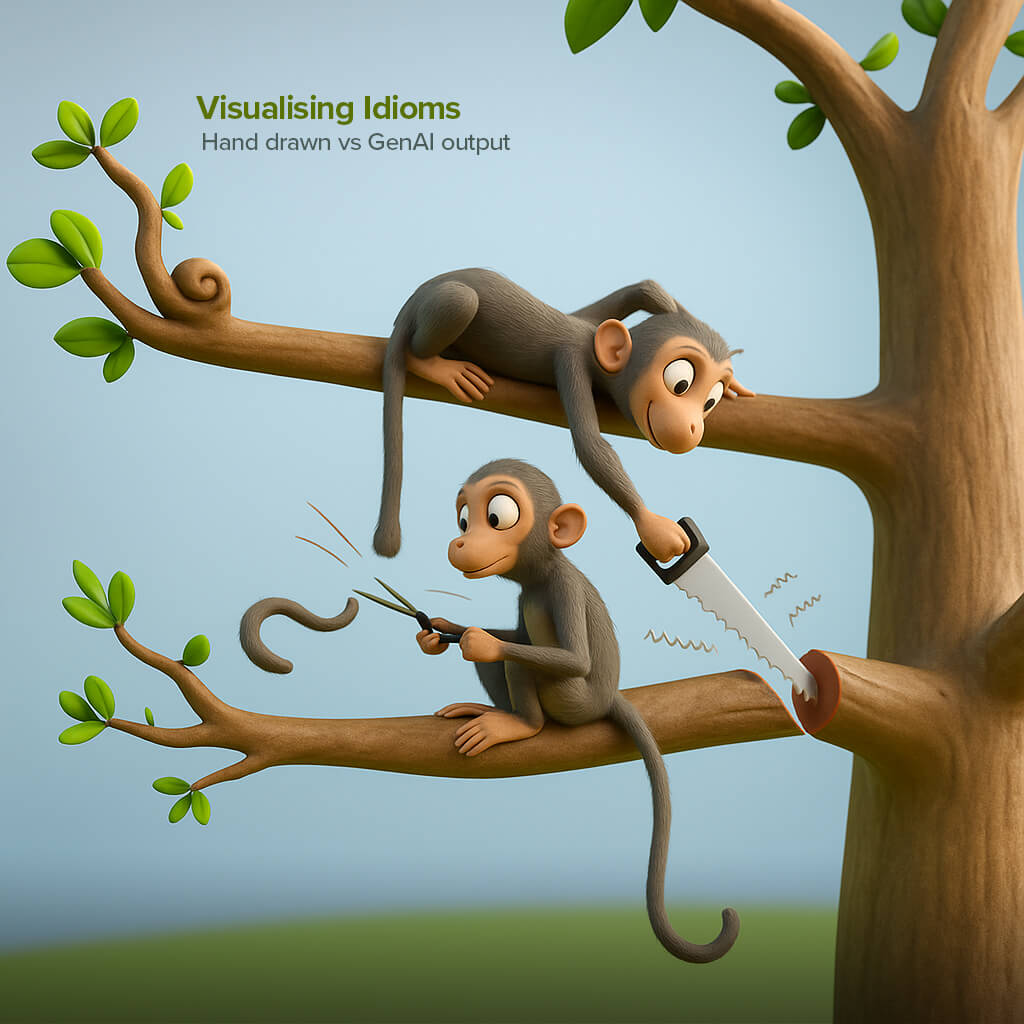
AI tools, like the scissors in the image, may seem helpful, giving quick and neat results. To novices, they might appear fast and clean at first glance. It is no surprise they are steadily improving and getting closer to what we desire. But in the long run, they should never replace our ability to think independently and critically. When we, as designers, surrender our thinking to tools, we risk becoming seekers of quick fixes rather than true problem solvers, cutting off the very branch we sit on.
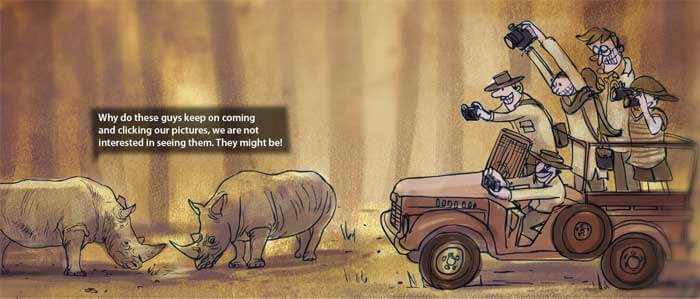
I refused to guide a zoo signage design project because zoos are human-centered, and animals do not choose to be watched. Instead, I suggested reframing the problem: design signage that helps humans hide from animals, using underground pathways and digital cues to indicate where animals might appear.
Evaluating the effectiveness of tactile marks on India’s new banknotes for the blind?
This study critically examines India’s new Mahatma Gandhi Series banknotes from the perspective of people with visual impairments (PVI). Although the redesign introduced vibrant colours and slight variations in size, it falls short of international accessibility standards. Denominations below INR 100 lack tactile features, and the minimal size differences make identification difficult.
A user study found that participants relied on makeshift techniques, struggled to distinguish between old and new notes, and frequently experienced errors and frustration. While mobile apps and signature guides are available, participants showed a clear preference for simple, reliable tactile cues. The study highlights the urgent need for more inclusive design to ensure equitable and independent use of currency.

Academics
My learnings and teachings
SHKEN MODEL
The paper discusses rationalising visual design decisions with respect to the arrangement of 2D elements in a pre-defined finite space.
DECONSTRUCTION - A METHOD TO DRAW 3D OBJECTS
The visual paper hypothesis that drawing with see-through objects can improve the performance of sketching amongst novices.
THE DESIGN JOURNEY
A ringside view of how design education in India has evolved over the years, as seen from the eyes of Prof. Sudhakar Nadkarni
HFG ULM BOOKLET
The booklet is a short narrative about the famous design school HFG Ulm. It is a conversation between two students where one of them builds an exact copy of the ‘Ulm stool’ by Max Bill.
UI/UX CHALLENGE
I am glad to release one of the classic assignment I give to students in my class. This assignment rationalises visual design decisions and guides you to think like a designer.
PACKAGING AND LABEL DESIGN
Introductory course to explore package design and label design through hands-on assignments engaging students into multiple mini-design projects.
SEMANTICS AND COMMUNICATION THEORY
In this course, students are taught how to design messages for various media. Communication here is understood as the act of decoding messages by the sender (designer) via a channel to the receiver (intended audience).
Projects
Project guidance and consultancy